
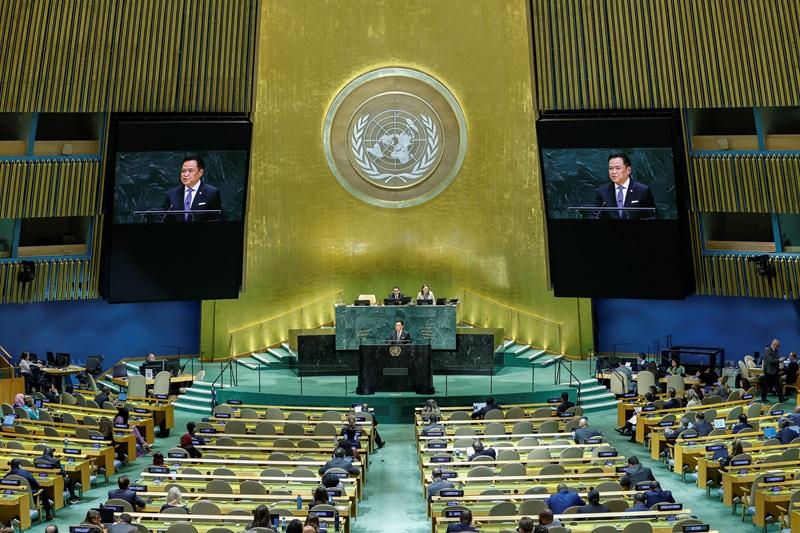
At a recent United Nations forum, leaders from developing countries emphasized the need for inclusive AI regulation to prevent worsening global inequalities and to ensure equitable benefits from artificial intelligence advancements.
During a United Nations session focused on artificial intelligence (AI), representatives from developing nations voiced strong calls for increased participation in the creation and regulation of AI technologies. These countries warned that AI, while transformative for economies, risks exacerbating global inequalities if its development and governance remain dominated by wealthy nations. Leaders from Africa, Asia, and Latin America stressed that developing countries should not be passive recipients of technology and standards crafted elsewhere but active participants in devising the rules that will shape AI’s future.
Foreign Minister Thérèse Kayikwamba Wagner of the Democratic Republic of the Congo highlighted the urgency of avoiding a replication of past economic imbalances, advocating for fair involvement in shaping AI norms. The debate underscored concerns around accountability, equitable benefits, and risk distribution, with the Bangladeshi Foreign Minister Khalilur Rahman noting the exponential increase in global attention to AI at the UN—from five delegations addressing it four years ago to 128 recently.
Experts and officials, including leaders from OpenAI and Anthropic, encouraged international cooperation to manage AI safely. The World Bank and International Monetary Fund have pointed out AI’s potential to accelerate development in poorer regions, potentially boosting Sub-Saharan Africa’s economy significantly over the next decade if infrastructural and skill gaps are addressed.
UN Secretary-General Antonio Guterres linked AI governance to broader themes of power and inclusion, urging coordinated global responses akin to those needed for climate change. Contrasting views were noted, including US President Donald Trump’s dismissal of AI risks as exaggerated. Meanwhile, Belize’s Prime Minister John Briceño underscored that well-governed AI could democratize knowledge and improve services, but poor regulation could deepen dependence and inequalities, especially in developing countries.
This discourse highlights the critical need for developing nations, including those with overseas workers and emerging economies, to engage actively in shaping AI policies that affect global development trajectories.
Sources referenced:
- https://www.gmanetwork.com/news/topstories/world/1004203/at-un-developing-nations-call-for-bigger-say-in-shaping-ai-future/story/