
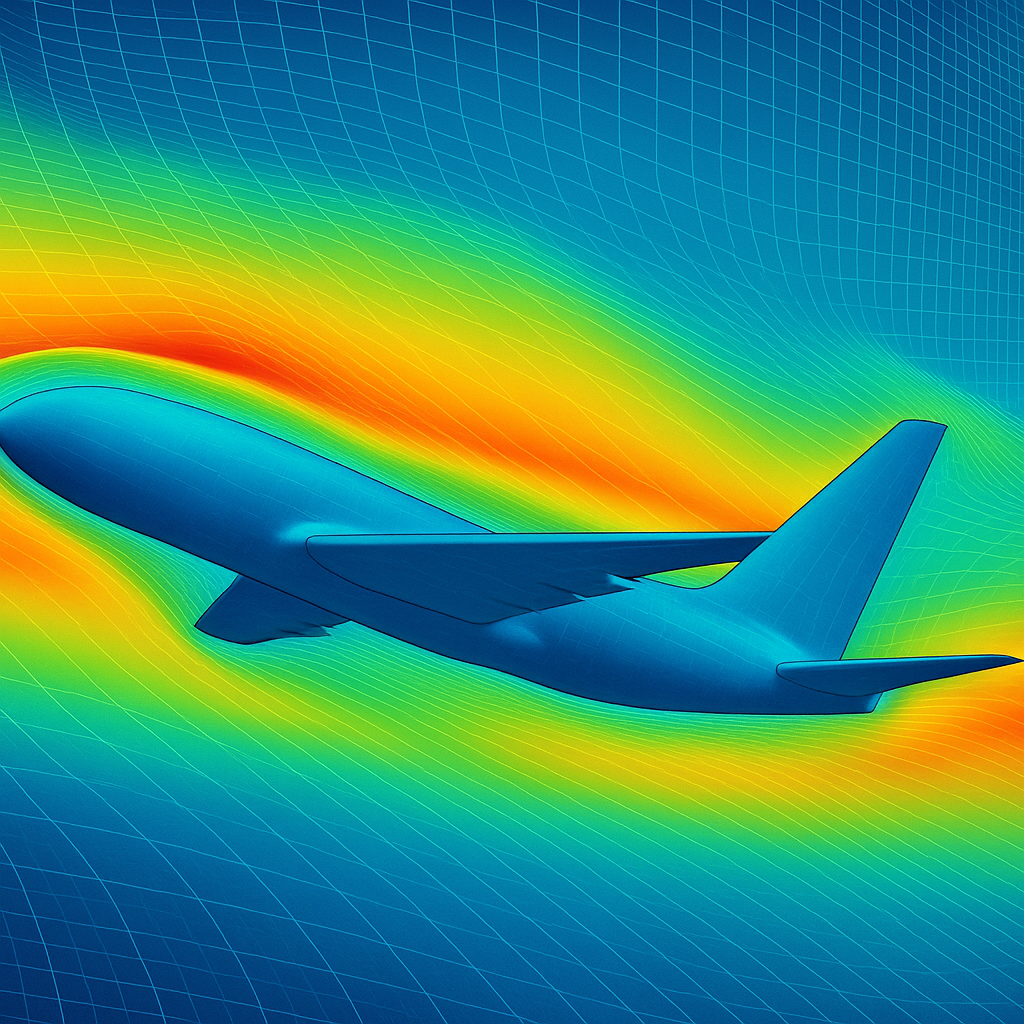
Computational Fluid Dynamics (CFD) employs numerical methods to simulate fluid behavior, offering insights critical to aerospace, engineering, meteorology, and biomedical fields.
Computational Fluid Dynamics (CFD) is a vital branch of physics and engineering that uses numerical methods and algorithms to analyze and predict the behavior of fluids and gases in diverse conditions. Central to CFD are the Navier-Stokes equations, nonlinear partial differential equations describing fluid motion by accounting for velocity, pressure, and viscosity. By solving these equations numerically, CFD enables simulation of complex fluid flows, offering valuable insights into physical phenomena.
Various numerical methods underpin CFD, including the finite difference method suited for simpler geometries, the finite element method for more complex geometries, and spectral methods. Prior to computation, a computational grid or mesh is generated to discretize the domain; its quality directly affects simulation accuracy and efficiency. Techniques like Delaunay triangulation and Voronoi tessellation are commonly employed to produce high-quality meshes.
Turbulence modeling presents particular challenges due to chaotic fluid motion, with models such as Reynolds-averaged Navier-Stokes (RANS) and Large Eddy Simulation (LES) providing approximations that allow more feasible computation.
CFD applications span aerospace engineering—advancing aircraft and spacecraft design—chemical engineering for reactor optimization, meteorology for weather prediction, and bioengineering through the study of blood flow, among others. As computational power grows, CFD’s role in enhancing our understanding and management of fluid systems continues to expand, making it indispensable to scientific and industrial advances.
The fundamental governing equations include the continuity equation (∇·v=0) and the Navier-Stokes equation governing momentum conservation, where v is velocity, ρ is density, p is pressure, and ν is kinematic viscosity. Discretization schemes such as the finite difference method approximate spatial derivatives to enable numerical solution.
This overview highlights the critical importance of CFD in research and practical applications, contributing significantly to the fields of engineering, environmental science, and health sciences.
Sources referenced:
- https://www.manilatimes.net/cdn-cgi/content?id=NiV5UC.CO2lLTniCCgnzMSvt_28q4mOCqbVl_VkFVdk-1791019250.3818982-1.2.1.1-7bNNLWlEpsx8MCyVhqEOqIx9DvLW_RRX6q0jTP35_0zqMLzoF69rj7M2fnu7XAts