
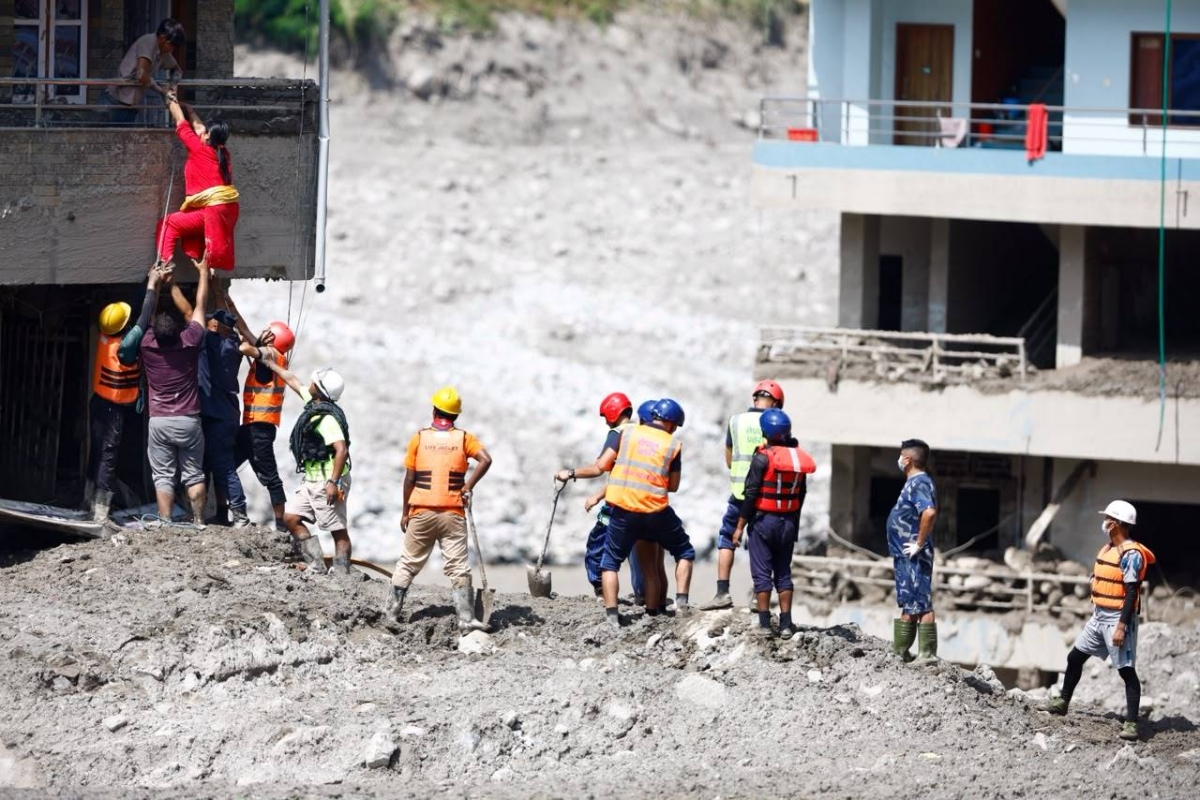
The recent devastating floods in Nepal's Rasuwa district highlight novel climate threats, emphasizing the urgent need to address emerging Himalayan environmental hazards beyond traditional risk management.
In recent years, Nepal’s Himalayan region has witnessed unprecedented environmental disasters, underscored by the catastrophic floods that devastated Rasuwa district in 2025 and 2026. These events, distinct in origin but severe in impact, reveal an alarming trend fueled by climate change and geological instability.
In July 2025, a sudden supraglacial lake drainage caused an intense flood that tore through the Rasuwa border corridor, leaving significant destruction in its wake. Merely thirteen months later, in August 2026, a different but equally catastrophic disaster struck the same valley: a rapid wall of mud, rock, and water descended following the collapse of rock and glacier ice near Langtang Lirung. This debris flow obliterated infrastructure and landscapes previously considered safe.
Scientific investigations are underway to decipher the complex chain of events leading to these disasters. Early studies suggest that rising temperatures are altering the physical environment of the high Himalayas, affecting permafrost stability and glacier dynamics. The August 2026 collapse, for instance, may be linked to the degradation of high-altitude permafrost, which compromises the structural integrity of mountain slopes.
These floods challenge traditional notions of natural disaster management in mountainous regions. As Carole Fuchs, who observed the area while filming a climate documentary, cautions, treating such catastrophic incidents as ‘ordinary floods’ risks normalizing extraordinary environmental hazards. Instead, there is an urgent imperative to develop adaptive strategies that anticipate novel and intensifying risks brought on by climate change.
The broader implications for development in Nepal and across the Himalayan belt are profound. Communities directly affected by these disasters face long-term recovery challenges, while policymakers and researchers must prioritize resilient infrastructure, early warning systems, and sustainable environmental stewardship. Such efforts are vital to safeguard the livelihoods, heritage, and well-being of increasingly vulnerable mountain populations.
This unfolding reality underscores the need for integrated scientific research and climate-responsive development planning in Nepal, particularly in ecologically sensitive districts like Rasuwa. Understanding and addressing the new dimensions of Himalayan hazards will be critical for sustainable development and disaster risk reduction in the region.
Sources referenced:
- https://thehimalayantimes.com/opinion/rasuwa-was-not-an-ordinary-flood-the-danger-is-making-it-normal