
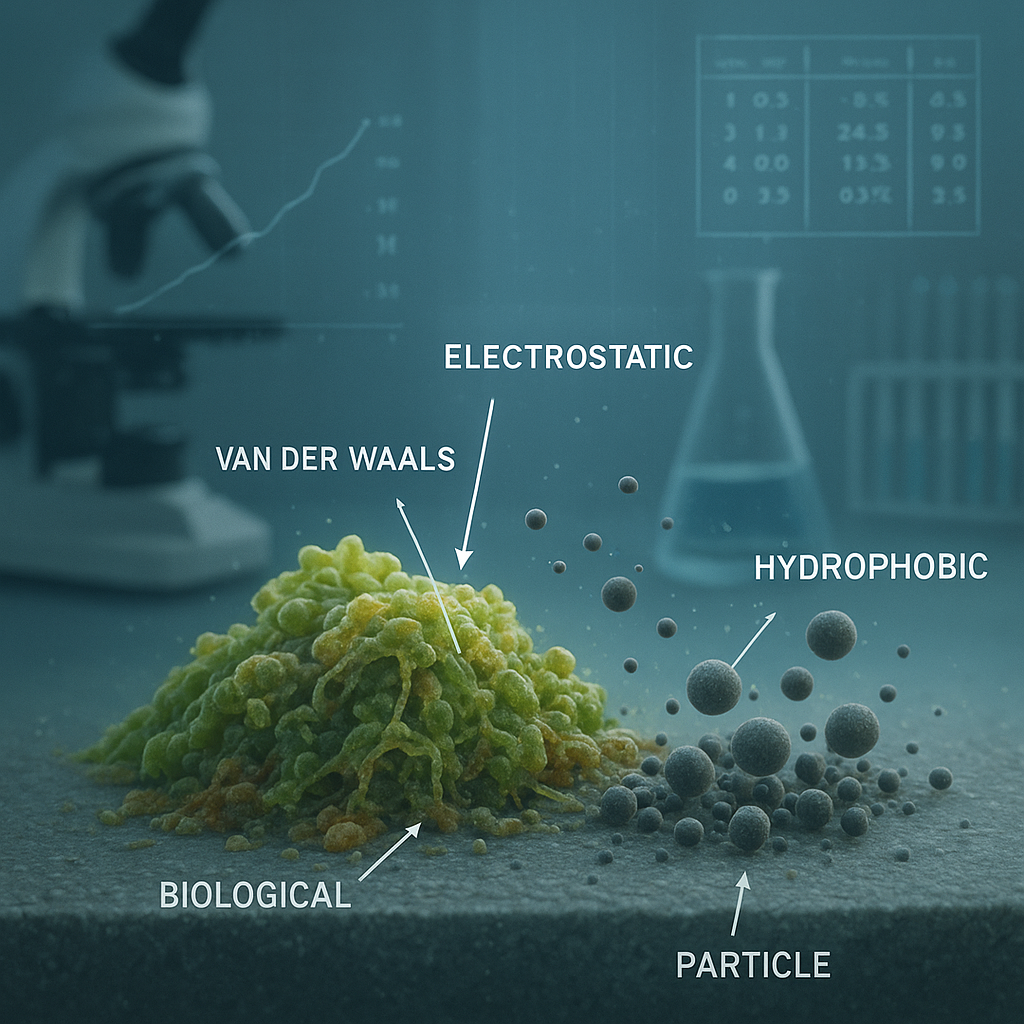
An in-depth exploration of fouling phenomena reveals the physical, chemical, and biological forces behind unwanted surface accumulations, offering insights for advancements in multiple scientific and industrial fields.
Fouling, the accumulation of unwanted substances on surfaces, presents challenges across disciplines such as engineering, biology, and materials science. These deposits, ranging from barnacles on ships to dental plaque, can cause efficiency losses, increased energy consumption, and health risks. Understanding fouling involves examining the interplay of physical, chemical, and biological forces that govern surface interactions. Physical forces like van der Waals attractions, electrostatic effects, and hydrophobicity influence the initial attachment of foulants, while chemical bonds—including covalent, ionic, and hydrogen bonds—establish stronger adhesion dependent on environmental conditions. Microorganisms also play a major role, producing extracellular polymeric substances that facilitate biofilm formation and complex fouling structures. To unravel these complexities, researchers rely on mathematical models describing the kinetics of foulant accumulation and removal, incorporating mass transport and surface reaction dynamics. For example, differential equations can predict the rate of foulant mass growth relative to time, aiding the development of anti-fouling strategies. Advances in fouling research hold promise for enhancing technologies in maritime, medical, and environmental sectors by improving surface management and sustainability. Continued interdisciplinary studies pave the way for innovative solutions to mitigate fouling’s negative impacts and potentially harness surface interactions beneficially.
Sources referenced:
- https://www.manilatimes.net/cdn-cgi/content?id=nwYsI9xfTZbKtt5yqTG7N_9B7g22cL5fbhc2PaDbazQ-1791670850.9526615-1.2.1.1-_UYXHzc2SYwINEr4v7BHVXS1hFGX9JmeNCG4jKUkzH3L6jRcasztdjoMEI8JxaHF